I saw this meme recently floating around the web.
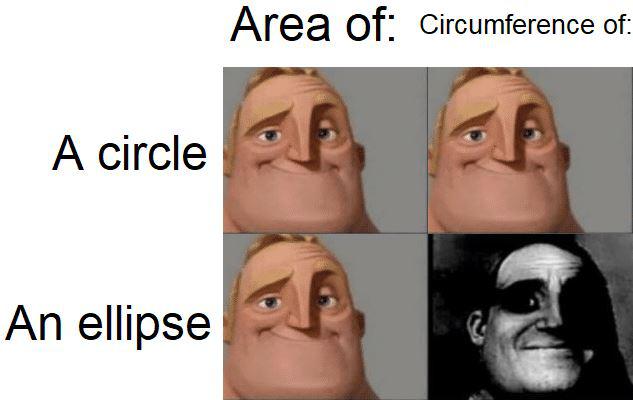
Surely it can’t be that hard to find the circumference of an ellipse? For axes of $a$ and $b$ wouldn’t it simply be something like $P=2\pi (a+b)/2$ in a similar way to a circle being $P=2\pi r$?
We can derive the formula ourselves to check this.
First we calculate the length of a small arc around the ellipse $dl$ and then sum them all together as we vary the angle and integrate $\theta$ from 0 to $2\pi$. For a very small length we can use Pythagoras and express the displacement in terms of $dx$ and $dy$.
$$ dl = \sqrt{dx^2 + dy^2} $$
To determine $dx$ and $dy$ we can use our knowledge of the coordinates of the points of an ellipse, $$ x = a \cos(\theta), \qquad y = b \sin(\theta), $$ and a quick derivative yields $$ dx = -a \sin(\theta) d\theta, \qquad dy = b \cos(\theta) d\theta. $$
Substituting this into our previous equation for $dl$, we can then express the length in terms of $\theta$ and $d\theta$ as $$ dl = \sqrt{a^2 \sin^2(\theta) + b^2 \cos^2(\theta)} d\theta $$ Having our length in this form is excellent as it is parameterised only by one variable. If we sum up all the angles from $\theta =0$ to $\theta=2\pi$ we can then derive $P$! Let’s do that.
$$ P = \int dl = \int_0^{2\pi} \frac{dl}{d\theta} d\theta = \int_0^{2\pi} \sqrt{a^2 \sin^2(\theta) + b^2 \cos^2(\theta)} d\theta $$
And a quick integration yields our closed form solution… oh I see. This integral is not integrable and is known as an Elliptic Integral.
For a circle both radii are equal $r=a=b$ and so since $\sin^2(\theta) + \cos^2(\theta)=1$ the integral simplifies rapidly by $$ P = \int_0^{2\pi} r d\theta = 2\pi r$$ which is our standard equation for the circumference.
Maybe now it makes some sense for why Mr Incredible looks so stressed.